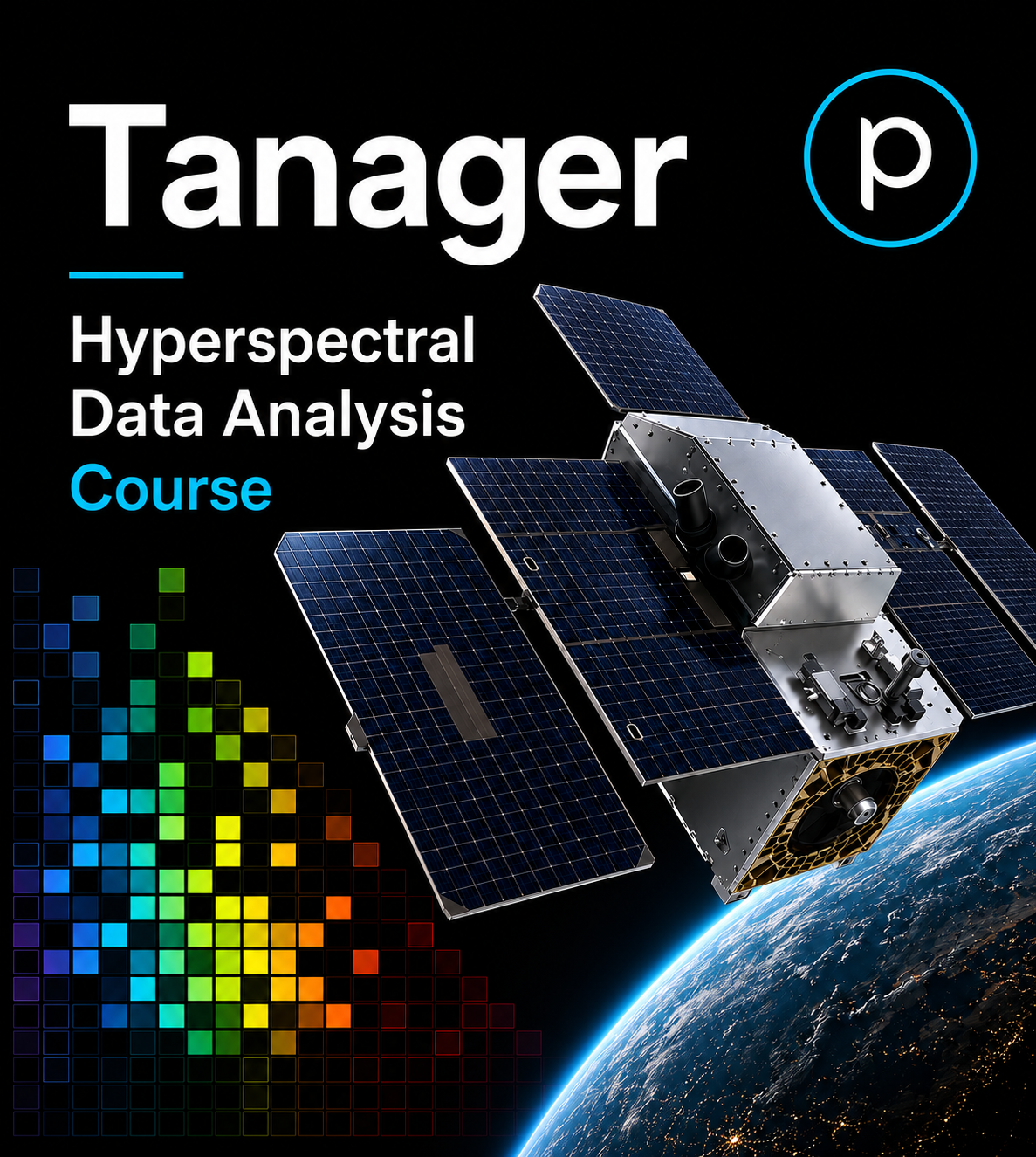
Tanager Hyperspectral Data Analysis Course
A practical learning resource for working with Planet’s Tanager hyperspectral data — from data discovery to preprocessing, spectral analysis, and machine learning.
5
Course modules
23
Guided lessons
20
Hands-on notebooks
55+
Figures & visualizations




Welcome to the hyperspectral data analysis course for Tanager, a practical learning resource for working with Planet’s Tanager hyperspectral data.
This course arrives at a pivotal moment where hyperspectral imaging is shifting from scientific exploration to operational reality. Flagship public space missions like PRISMA, EnMAP, and EMIT have successfully demonstrated the science of spaceborne spectroscopy. Moving beyond research, users want to drive daily decisions in agriculture, climate, and industry.
Planet’s Tanager program is built for that operational era. Tanager is an imaging spectrometer capturing 400+ contiguous bands across the visible-to-shortwave infrared (roughly 380–2500 nm) at ~30 m resolution, with Planet planning additional satellites to expand coverage. Through the Carbon Mapper partnership, powered by technology from NASA’s Jet Propulsion Laboratory, Tanager is also designed to support high-impact use cases like emissions detection and environmental monitoring.
To support hands-on learning, Planet provides selected Tanager-1 hyperspectral datasets through its Open Data STAC. This course uses those datasets as a practical entry point into hyperspectral data analysis.
Course modules
The Tanager mission and the HDF5-EOS structure behind every scene.
The physics of the products: radiance vs. reflectance, basic vs. ortho.
Masking and band removal for analysis-ready cubes.
Spectral indices, dimensionality reduction, and machine learning.
The integrated Python toolkit that ties the whole workflow together.
See how the five modules fit together and what you will build along the way.
TanagerSpec companion toolkit

TanagerSpec and this course are built as paired resources.
The course explains the concepts and workflows, while TanagerSpec implements these and additional features as a Python package purpose-built for Tanager data.
Aim
The primary aim of this course is to bridge the gap between spectroscopy theory and operational hyperspectral data analysis. The course equips Earth observation professionals and students with the technical confidence to access, process, visualize, and interpret high-dimensional data from Planet’s Tanager mission. By reducing technical barriers and clarifying the structure of Tanager data products, the course helps learners identify spectral patterns, extract meaningful information, and build scalable Python-based workflows.
By the end of the course, you will be able to work confidently with Tanager hyperspectral data, from data discovery and product selection to preprocessing, spectral analysis, machine learning, and geospatial output generation.
Authorship and acknowledgements
This course was independently designed, edited, and developed by Abdelrahman Saleh, a PhD researcher at the University of Manitoba. The course was developed during his research internship at Planet Labs PBC, with support from Mitacs through the Mitacs Accelerate program.
The author gratefully acknowledges the valuable technical feedback and support provided by members of Planet Labs PBC during the internship. Special thanks are extended to Keely Roth, the author’s mentor at Planet Labs PBC, for her thoughtful review of the course lessons and constructive feedback. The author also sincerely thanks Nasem Badreldin, the author’s PhD supervisor, for his support, and encouragement throughout the project.
To learn more about the course author, visit the Author page.
Course author and affiliated organizations: Abdelrahman Saleh, University of Manitoba and Planet Labs PBC.